Desengrasantes: Tipos, funcionamiento y elección
Los desengrasantes son un elemento básico en muchos inventarios. Pero elegir el desengrasante adecuado para el trabajo es tan importante como tener uno a mano.
Con demasiada frecuencia, los equipos de mantenimiento y los ingenieros recurren al primer desengrasante que tienen a mano, sin conocer las alternativas que pueden ser más rápidas, eficaces y seguras.
Hoy en día, existe una amplia gama de fórmulas para satisfacer tus requisitos exactos, tanto si trabajas con maquinaria pesada como con componentes electrónicos sensibles o en entornos aptos para alimentos.
En esta guía cubrimos todo lo que necesitas saber para elegir el desengrasante adecuado para tu inventario.
¿Tienes alguna pregunta que no esté respondida aquí? Ponte en contacto con nuestro equipo para obtener la ayuda que necesitas¡!
Guía rápida:
- ¿Qué son los desengrasantes?
- Métodos para realizar el desengrase
- Los tipos de desengrasantes industriales explicados: A base de agua, a base de disolvente y especializados
- Problemas resueltos por los desengrasantes
- Cómo elegir: puntos a tener en cuenta
- Tus proveedores de desengrasantes
¿Qué son los desengrasantes?
Los desengrasantes son un tipo de agente limpiador utilizado para eliminar la grasa, los aceites, la suciedad y otros contaminantes de las superficies. Como parte de los suministros de Mantenimiento, Reparación y Operaciones (MRO), los desengrasantes desempeñan un papel crucial en los programas de mantenimiento y son un elemento básico en los inventarios de todo el mundo.
Sin embargo, no todos los desengrasantes son iguales. Elegir el adecuado depende de varios factores, entre ellos: el área de aplicación, la formulación, el material de la superficie y cualquier consideración de seguridad o medioambiental.
Los desengrasantes pueden variar desde soluciones ligeras para superficies de hostelería y comercios hasta potentes fórmulas industriales diseñadas para limpiar cajas de cambios, motores y componentes de construcción.
Métodos para realizar el desengrase
Degreasing is the process of removing contaminants such as grease, oils, waxes and dirt from surfaces, typically as a precursive step before carrying out maintenance repairs, painting, sanitising or assembly.
At its most basic form, degreasing ensures surfaces are clean and free from contaminants.
Degreasing can be carried out through a number of different methods including:
- Manual cleaning with sprays, wipes, or brushes
- Soaking or immersion in degreasing solutions
- High-pressure spraying or automated cleaning systems
The types of degreasers explained:
Water-based degreasers:
Water-based degreasers (also known as aqueous degreasers) are a type of degreaser cleaning agent that are formulated primarily with water as the main solvent.
Unlike solvent-based degreasers, which rely on organic solvents such as hydrocarbons or alcohols, water-based degreasers combine surfactants, detergents, or other additives to help break down and remove oils, greases, and other contaminants from surfaces.
Water-based degreasers are typically less toxic, less flammable, and more environmentally friendly compared to solvent-based alternatives. They are often used for general cleaning tasks where safety and environmental concerns are a priority.
How do water-based degreasers work?
Water-based degreasers work by utilising the properties of surfactants (detergents) to break down and lift oils, grease, and contaminants from surfaces. Surfactants lower the surface tension between water and greasy contaminants, allowing for better penetration and emulsification of the grease or oil.
Surfactants work through:
- The hydrophobic (non-polar) end: binds to oil, grease, and other non-polar contaminants.
- The hydrophilic (polar) end: interacts with the water and helps to lift the contaminants away from the surface.
Surface tension is the result of cohesive forces between liquid molecules. At the surface, water molecules have no molecules above them to bond with, so they pull inward more tightly, creating a surface that resists external force. In surface cleaning, the high surface tension of water means water has difficulty spreading and penetrating oily or greasy surfaces. The surfactant content of water-based degreasers lower the surface tension, making it easier for water-based formulations to spread out and break down greases.
The surfactants in the degreaser break down the grease into small particles, creating an emulsion. The emulsion allows the grease and oil particles to be suspended in water, making it easier to wash or wipe the contaminants off the surface.
Featured NCH water-based degreasers:
- Aqua-Sol Silicate Free: Deep cleaning degreaser, that contains a special penetrating emulsifier that removes even the most stubborn soils. Does not contain silicates and is therefore safe to use around glass surfaces. Ideal for degreasing: CNC machines; Food display cabinets; Food packaging equipment; Food production machinery and equipment; Worktops.
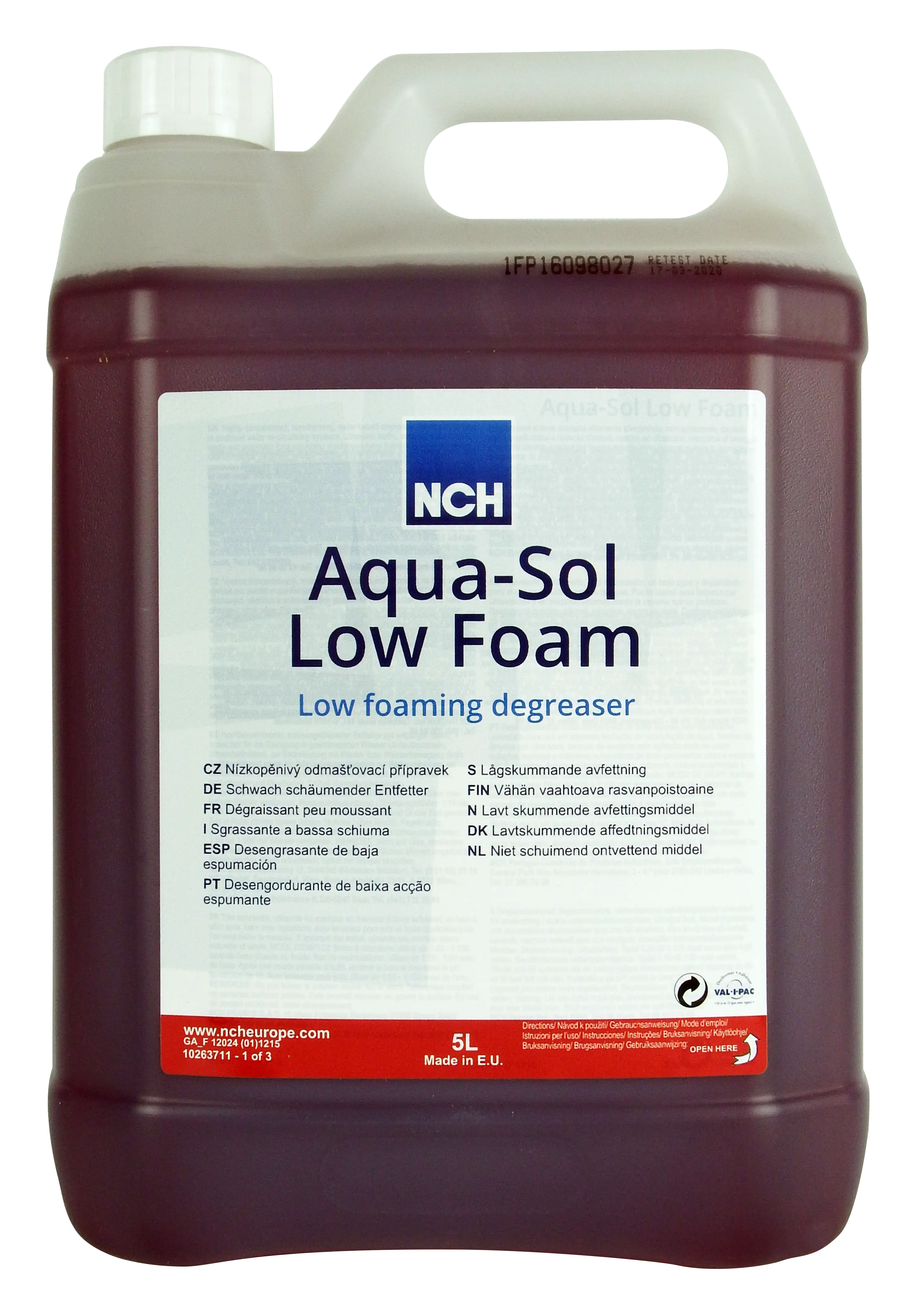
- Aqua-Sol Low Foam: Low foaming degreaser, suitable for use as a general degreaser and for use in enclosed partswashers, ultra sonic baths and closed water re-circulating systems. Alkaline water based degreaser that contains corrosion inhibitors that protect metal parts, NSF A1 & A2 Accreditation. Concentrated cleaner which removes heavy grease, oil and dirt deposits. Suitable for ceramics, marble, metals, natural stone, vinyl floors.
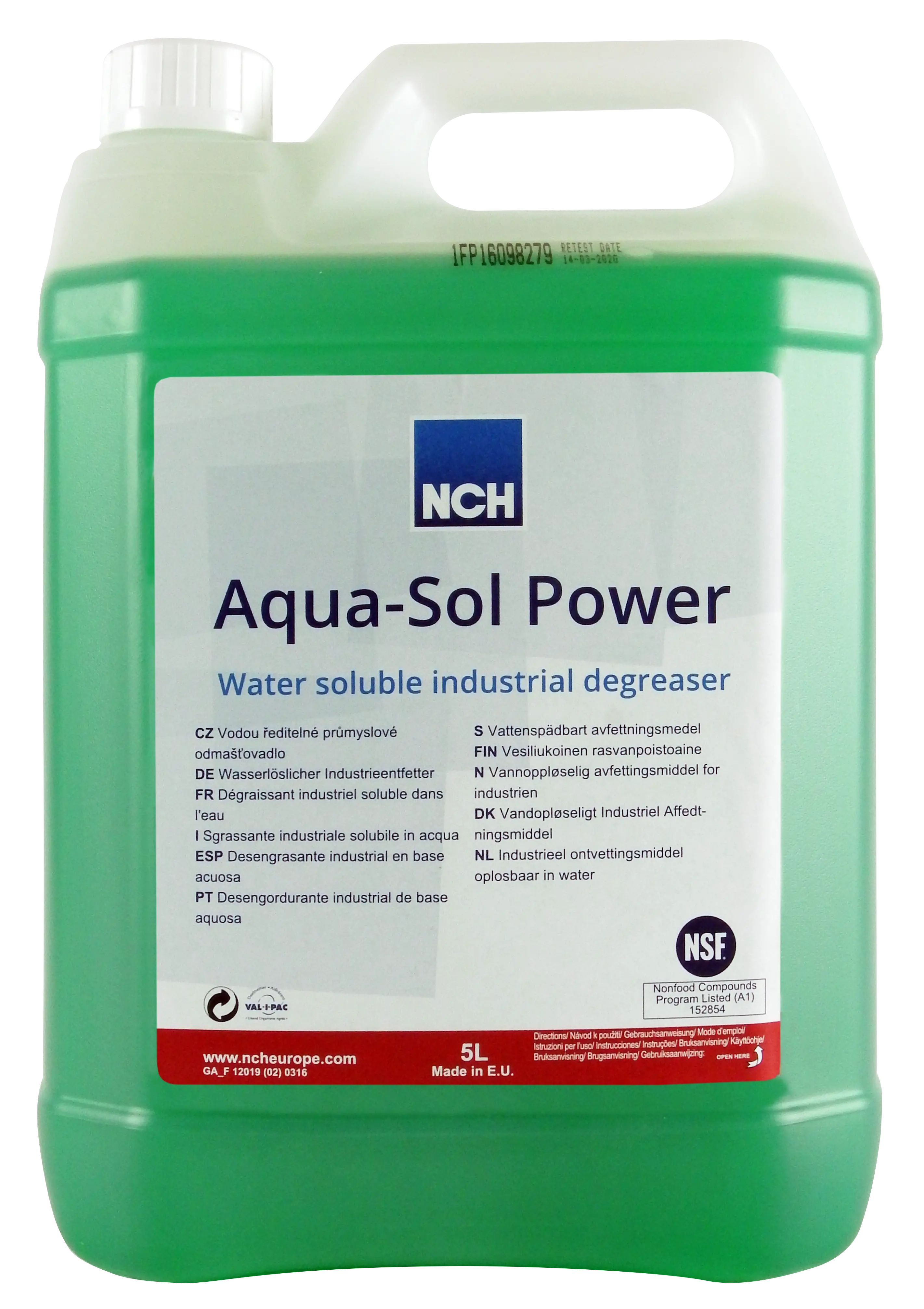
- Aqua-Sol Power: Uses the very latest in surfactant technology to cut through grease and grime with ease, accredited to NSF A1. Contains additives that help to break the bond that holds greasy soils to surfaces. Removes grease, oil, wax, carbon, inks, dye, creosote, mildew and other stubborn soils from surfaces.
Speak to our experts to discuss your options and begin your order today.
Solvent-based degreasers:
Solvent-based degreasers are powerful cleaning agents that rely on organic solvents to dissolve and remove grease, oils, waxes, tar, adhesives, and other stubborn hydrocarbon-based contaminants from surfaces. These degreasers are especially effective in industrial environments where heavy-duty cleaning is required, such as: manufacturing plants, maintenance workshops, automotive garages, and heavy equipment operations.
Solvent-based degreasers work by chemically breaking down the bonds that hold grease and grime together. They penetrate deep into the contaminant layer and lift it from the surface, allowing for easy removal by wiping, rinsing, or mechanical agitation. Because of their strong solvency power and rapid action, they are ideal for applications where speed, efficiency, and minimal mechanical effort are priorities.
There are several types of solvent-based degreasers available, including:
- Petroleum-based solvents: such as mineral spirits and kerosene.
- Chlorinated solvents: offer high degreasing strength but may raise environmental and health concerns.
- Non-chlorinated solvents: often chosen as safer or more environmentally friendly alternatives.
- Speciality blends: engineered for fast evaporation, low odour, residue-free results, or compatibility with sensitive materials like electrical components.
How do solvent-based degreasers work?
Solvent-based degreasers are primarily composed of organic compounds designed to break down and dissolve oils, greases, and other hydrocarbon-based contaminants.
Solvent based degreaser product recommendations:
At NCH, we offer a number of solvent-based degreaser solutions to tackle your industrial degreasing jobs.
Featured NCH solvent degreasers:
- Full Back C: Powerful degreaser that dissolves the toughest oil, grease, tar and grime with little or no scrubbing. Has a foaming emulsion that clings to vertical surfaces for heavy duty cleaning. Suitable for: aluminium, concrete, copper, mild steel, stainless steel
- Solvo Kleen: Industrial solvent degreaser that provides powerful cleaning for electrical and mechanical equipment and metal parts. Suitable for: insulation, mild steel, stainless steel, most metals, painted surfaces, plastics, rubber
- Solvo Kleen 40: Industrial solvent degreaser with high purity, low odour and powerful cleaning for all types of critical surfaces. Suitable for: aluminium, concrete, copper, mild steel, stainless steel, painted surfaces, plastics.
Speak to our experts to discuss your options and begin your order today.
Specialist degreasers:
Unlike solvent-based and water-based/aqueous degreasers, specialist degreasers are categorised by their purpose or application area, rather than the chemical formulation.
Depending on the application area, specialist degreasers may be required to tackle recurring contaminants and grease types on specific surfaces.
Common specialist degreasers:
- Food-safe degreasers: formulated to meet NSF or similar food industry standards. Ideal for food production areas where contact with food surfaces may occur.
- Electrical contact degreasers: non-conductive, fast-evaporating and residue-free; designed for cleaning electronic or electrical components.
- Biodegradable or eco-safe degreasers: made with environmentally-friendly ingredients, meeting regulatory requirements for low toxicity and rapid biodegradation.
Issues solved by degreasers:
- Prevents wear and overheating: Removes build up of contaminants keeping the equipment running at optimum temperature and smoothly
- Minimises unexpected shutdowns: A regular maintenance cleaning schedule identifies potential issues which can be rectified before it causes a major issue
- Extends equipment life: By removing contaminants, degreasers help in extending the lifespan of expensive equipment and machinery, reducing cost for replacement
- Faster cleaning process: Effective degreasers work to dissolve oils, grease and dirt quickly reducing the time spent on manual labour.
- Helps reduce number of repairs: Regular use of degreasers keeps your parts clean reducing wear and tear therefore extending equipment life
- Lower downtime: A fast and easy cleaning process gets equipment back into service quicker thereby increasing overall productivity
Making your choice: points to consider
Selecting the right degreaser can mean the difference between fast, effective cleaning and potential surface damage or safety risks. Whether you need a high-foaming cleaner to tackle baked-on industrial grease or a low-foaming option for delicate equipment, choosing the correct product is vital.
Here are the key considerations when selecting a degreaser:
- Type of surface: Not all surfaces respond the same to degreasers. Some materials, like aluminium, painted surfaces, rubber, or plastics, may be sensitive to harsh solvents or high-pH formulations. Always check material compatibility to avoid discolouration, corrosion, or degradation.
- Type of grease/contaminants: Different degreasers are formulated to tackle different types of soiling. Heavy industrial grease, carbon deposits, tar, food-based oils, waxes, and general grime all require different cleaning strengths and mechanisms. Consider whether you’re dealing with petroleum-based residues, biodegradable oils, or carbonised materials.
- Cleaning method: The method of degreasing can significantly influence the type of product you need. Whether you’re applying it manually with a cloth or spray bottle, or using a parts cleaner such as our Torrent 500 or Torrent 700, the formulation matters. Some degreasers are designed to foam and cling to vertical or uneven surfaces, allowing extended contact time. Others are formulated for low-foaming or rinse-free performance, ideal for enclosed systems or sensitive components.
- Use cases and environment: If you’re cleaning in a confined space, food preparation area, or flammable zone, you’ll need to factor in the degreaser’s toxicity, flammability, ventilation needs, and compliance with industry standards (e.g., NSF accreditation, VOC limits).
- Drying Time and Residue: Some applications require fast-drying, residue-free cleaning, for instance, in electronics or precision components. Others may tolerate a slower drying time if deeper penetration or longer dwell time is needed. Choose a product that aligns with your workflow and avoids the need for extra rinsing or wiping.
Your trusted degreaser suppliers
At NCH, we bring over 100 years of experience in supplying businesses, large and small, across the globe with reliable Maintenance, Repair, and Operations (MRO) solutions. We formulate, manufacture, and distribute our products directly, ensuring you receive the highest quality consumables at the most competitive prices.
Our degreaser range extends far beyond industrial-grade products for high-volume operations. We support teams across a wide range of sectors, offering solutions tailored to your specific environment. From everyday surface cleaning for hospitality teams to specialised degreasers for electrical equipment and food preparation areas, our portfolio covers it all.
Whatever your industry or cleaning challenge, we’re here to help you get the right degreasing solution, quickly, efficiently, and with expert support.
Explore our range of industrial maintenance products, or for more information, get in touch with our friendly experts today.